AI: A Serious Look at the Big Questions—HDSI 2024 Workshop Recap
Yesterday, the Harvard Data Science Initiative (HDSI) hosted the workshop AI: A Serious Look at the Big Questions, bringing together an impressive lineup of experts to explore the profound and often challenging questions surrounding artificial intelligence. Taking place at the Science and Engineering Complex (SEC) in Boston, this interdisciplinary discussion featured thought leaders from neuroscience, psychology, biomedical informatics, epidemiology, and industry research, all converging to examine the ethical, philosophical, and technical frontiers of AI.
The session was led by Andrew L. Beam, Assistant Professor at the Harvard T.H. Chan School of Public Health, with expert insights from:
Samuel J. Gershman, Professor of Psychology, Harvard Faculty of Arts & Sciences
Marinka Zitnik, Assistant Professor, Department of Biomedical Informatics, Harvard Medical School
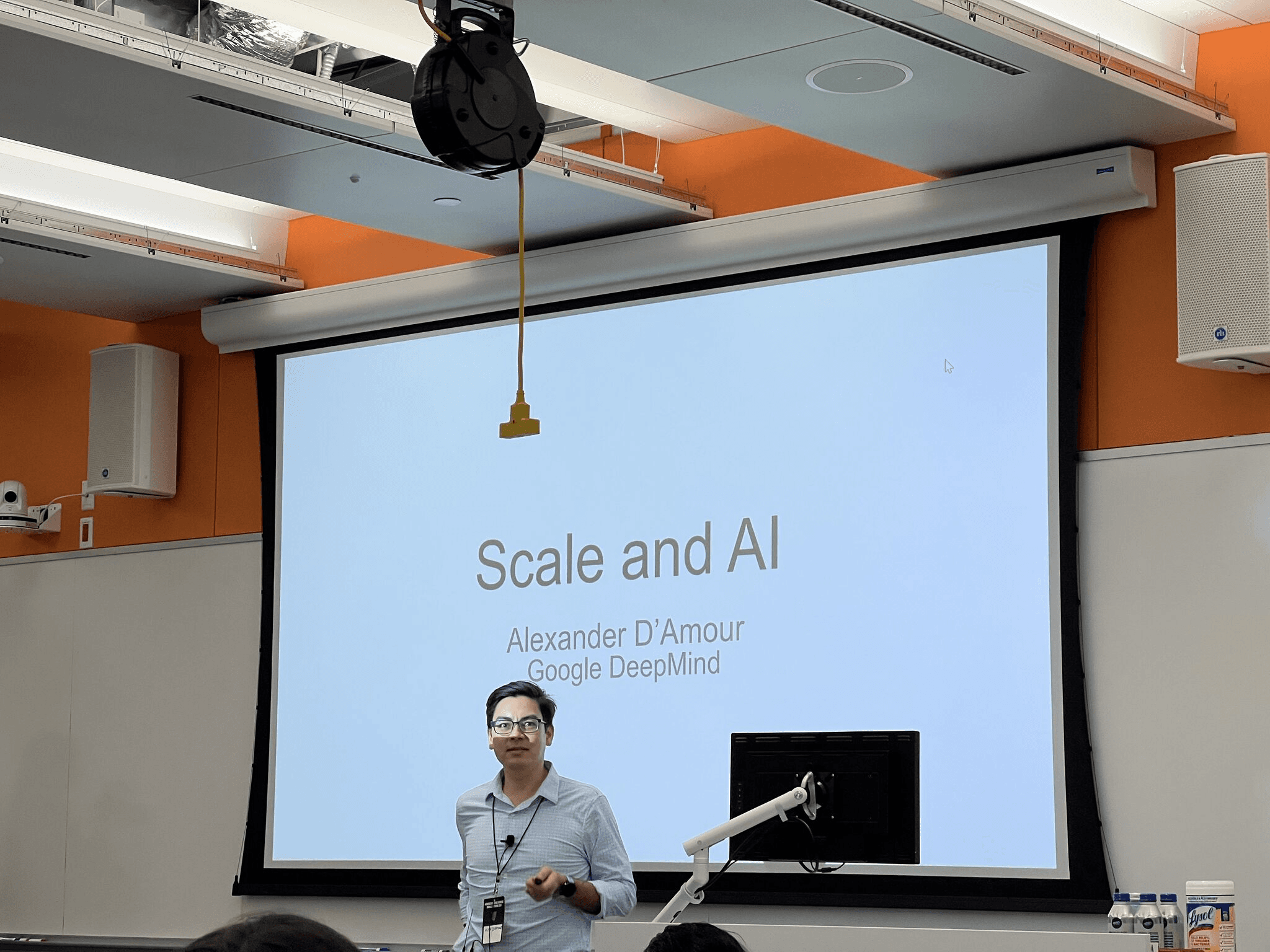
Alexander D’Amour, Research Scientist, Google DeepMind
From cognitive science to biomedical discovery to large-scale AI models, the conversation spanned diverse fields while focusing on the deeper theoretical and practical dilemmas AI presents today.
Challenging the AI-Human Intelligence Comparison
The workshop opened with Samuel J. Gershman, who tackled the question: To what extent do current AI approaches mirror human intelligence? His talk reframed AI progress through the lens of inductive biases—the preconceptions that shape how humans and AI alike process and predict information. Gershman emphasized that human intelligence is defined not just by raw computational power, but by its ability to generate and prioritize problems rather than just solve predefined ones. This concept, which he called the problem problem, questions whether AI can truly be creative or if it will always depend on humans to define its purpose.
When Will AI Make Its First Major Scientific Discovery?
Marinka Zitnik took the stage to explore a provocative question: When will AI independently make a major scientific discovery? While AI tools like AlphaFold have already revolutionized biology, Zitnik argued that these breakthroughs still rely heavily on human-defined constraints and domain-specific knowledge. She outlined three major barriers AI must overcome before it can achieve true scientific autonomy:
Developing Generalizable Inductive Biases – AI currently lacks the ability to define its own biases in a way that systematically guides hypothesis generation.
Divergent and Skeptical Reasoning – AI needs to balance creativity with scientific skepticism, ensuring that it doesn’t simply generate plausible-sounding but untestable theories.
Autonomous Experimental Validation – Without a way to independently design and execute experiments, AI remains a tool rather than an agent of discovery.
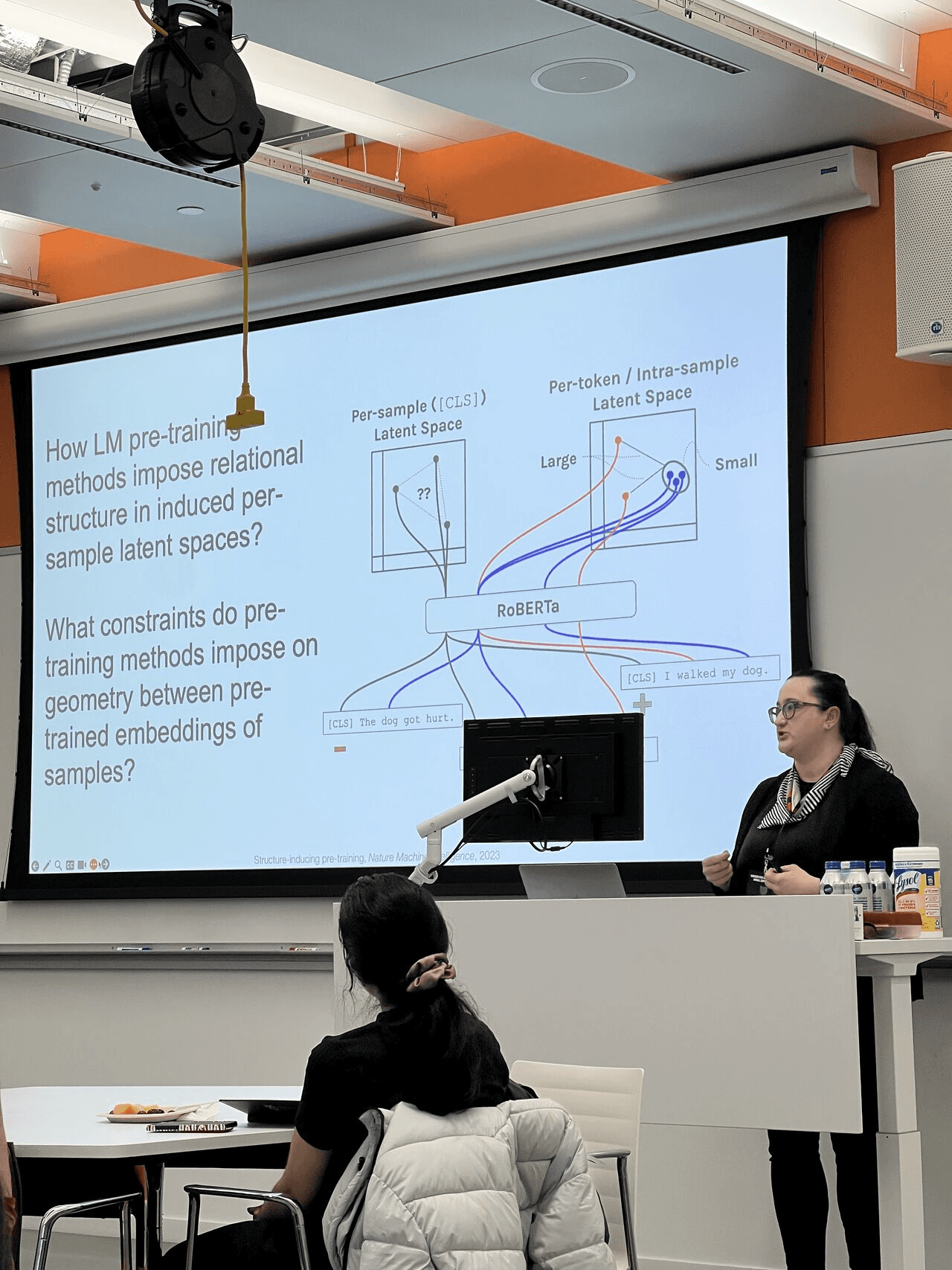
Zitnik’s discussion underscored that while AI is an increasingly powerful collaborator in research, it is not yet an independent scientist.
The Limitations of the Scaling Approach in AI
Rounding out the panel, Alexander D’Amour critically examined the prevailing scaling approach in AI—the belief that simply increasing computational power and data will lead to more powerful models. He pointed out that while models like GPT-4 and AlphaFold are impressive, they operate as syntactic transformers rather than semantic reasoners. This distinction raises concerns about their true understanding of complex problems.
D’Amour’s key arguments included:
Scaling alone is not enough – AI lacks causal reasoning and struggles with extrapolation beyond training data.
The “you-know-what-I-mean” problem – AI appears to understand human language because it mimics our patterns, but it does not deeply reason about context.
AI’s creative limitations – While AI can recombine existing knowledge in new ways, it still struggles to independently define what is worth discovering.
He suggested that the future of AI will likely rely on hybrid human-AI systems, where AI assists but does not fully replace human scientists.
Cutting Through the Hype: Where Is AI Headed?
The workshop concluded with an interactive panel discussion, in which speakers debated AI’s trajectory and societal impact. The key takeaways? AI is undeniably transformative but remains far from achieving human-like cognition or scientific autonomy. Instead of chasing unrealistic expectations, the field should focus on building AI systems that augment human decision-making, ensuring transparency, reliability, and ethical considerations remain central.
As AI advances, workshops like this remind us to ask the big questions—not just about what AI can do, but about what it should do.
Check out the workshop here!