Google Cloud Next '24 Blog Series: AI at Scale - How Enterprises Are Transforming Media, Finance, and Operations with Generative AI
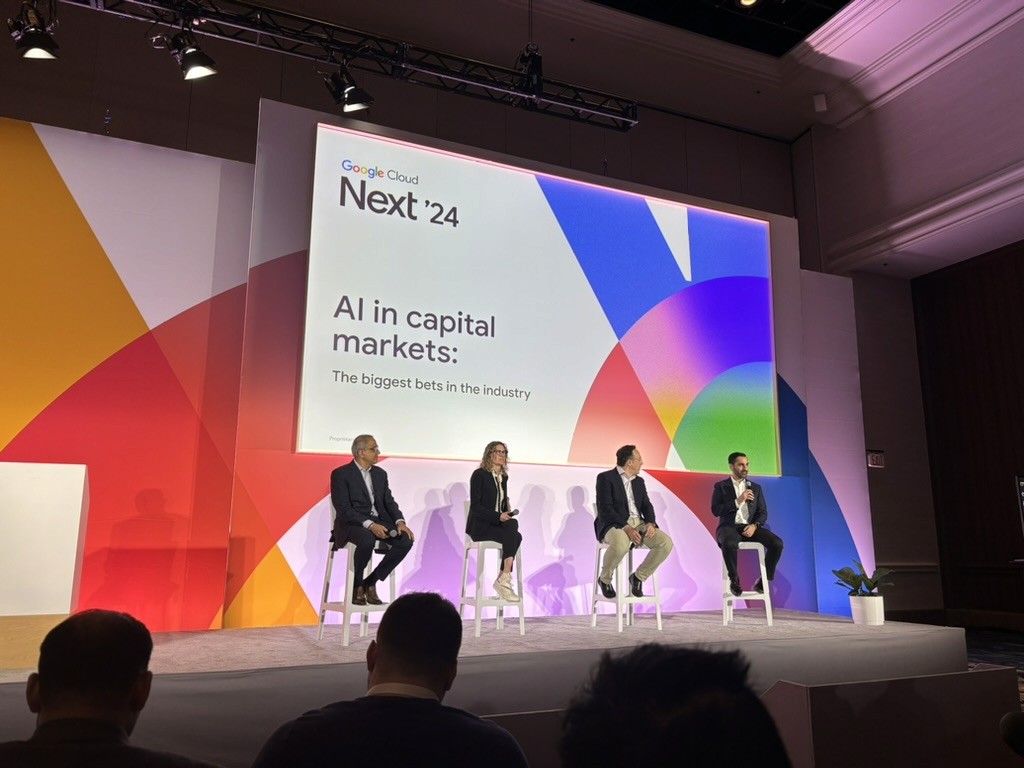
At Google Cloud Next '24, industry leaders from Paramount+, Citadel Securities, CME Group, Charles Schwab, and BCG X converged to discuss the real-world impact of AI across industries. From media and entertainment to capital markets and enterprise operations, these sessions revealed the most compelling AI use cases, the biggest technical challenges, and the emerging frameworks for scaling AI from proof of concept to enterprise-wide transformation.
1. The AI-Powered Content Revolution: How Paramount+ Is Reinventing Streaming
Paramount+ is leveraging Google Cloud’s Vertex AI to automate metadata generation and video summarization, cutting down on thousands of hours of manual labor. Their use of LLMs for video content processing has transformed their personalization pipeline, making content more discoverable and relevant.
Key Takeaways:
Metadata Automation: With over 50,000 videos requiring metadata tagging and summarization, Paramount+ turned to AI to eliminate manual processing costs and gain finer control over content details.
Personalization with AI: AI-driven metadata enrichment powers enhanced content recommendations, ensuring users receive highly relevant suggestions tailored to their viewing habits.
Technical Execution: By leveraging prompt chaining, function calling, and fine-tuning, Paramount+ improved AI-generated video summaries while maintaining quality standards.
Future Goals: Moving towards reinforcement learning for continuous fine-tuning, ensuring AI-driven recommendations adapt dynamically to user behavior.
What the Experts Say:
Adam Leary, VP of AI/ML at Paramount Streaming, explained that AI isn’t just boosting efficiency—it’s redefining how content is organized, categorized, and recommended. By shifting from manual curation to AI-assisted workflows, Paramount+ can scale content operations like never before. Tereza Manukian, Lead Product Manager at Paramount Global, emphasized that getting AI to “understand” content requires careful prompt engineering, ensuring AI-generated summaries resonate with audiences. Meanwhile, Google Cloud’s James McCabe and Sofyan Saputra revealed that Vertex AI’s real-time adaptability is key to evolving recommendations in response to new content trends.
2. AI in Capital Markets: Powering Risk Management and Trading Decisions
Citadel Securities, CME Group, and Charles Schwab are integrating machine learning and generative AI to optimize trading strategies, liquidity management, and market insights.
Key Takeaways:
Quantitative Trading at Scale: Citadel Securities leverages AI to analyze vast amounts of market data, enhancing price prediction models and optimizing trade execution.
CME Group’s Risk Modeling: AI is being used to generate synthetic financial risk scenarios, allowing traders to test investment strategies under varying market conditions.
Intelligent Search & APIs: CME Group is developing AI-driven APIs for real-time market insights, enabling automated margin calculations and portfolio stress testing for institutions like Charles Schwab.
AI and Elastic Cloud Computing: The ability to scale compute power on demand ensures real-time financial modeling remains cost-effective and efficient.
What the Experts Say:
Costas Bekas, Head of Research Platform at Citadel Securities, explained that AI’s role in quantitative trading is not about replacing human expertise but augmenting it, ensuring that traders can react to market changes faster. He noted that unsupervised learning models are particularly effective in finding patterns in alternative data sources, driving higher accuracy in market predictions.
Sunil Cutinho, CIO at CME Group, focused on the importance of AI in market risk modeling, sharing that synthetic risk scenarios help financial institutions stress-test portfolios under various economic conditions.
Katie Meyers, SVP at Charles Schwab, underscored AI’s impact on compliance and fraud detection, ensuring AI-powered systems meet regulatory standards while improving customer experience. Meanwhile, Rohit Bhat, Managing Director at Google Cloud, noted that AI-driven APIs are enabling faster, more efficient liquidity management strategies that benefit both institutional and retail investors.
3. From Proof of Concept to Impact: Scaling AI Across the Enterprise
BCG X and Google Cloud highlighted the gap between AI hype and real business outcomes, emphasizing the need for structured AI deployment programs.
Key Takeaways:
Beyond Use Cases: AI as a Business Transformation Tool
Companies must rethink entire workflows, not just add AI as a feature.
AI’s value comes from redefining processes, automating high-friction tasks, and enhancing human decision-making.
Enterprise AI Adoption Trends:
95% of executives rank AI as a top priority, but 65% are dissatisfied with progress.
Successful companies are shifting from scattered pilots to structured AI adoption programs.
AI Governance & Responsible AI:
AI models must be continuously evaluated, fine-tuned, and governed.
AI safety, bias mitigation, and ethical considerations must be baked into development pipelines.
The Future of AI in Business:
AI will reshape functions like customer service, marketing, and finance.
Expect AI-powered automation in compliance, fraud detection, and hyper-personalization.
Companies investing in custom AI models will gain significant competitive advantages.
What the Experts Say:
Carrie Tharp, VP of Strategic Industries at Google Cloud, emphasized that most companies fail not because of AI’s technical limitations but because of a lack of clear strategy and execution. She stressed that AI implementation must be deeply tied to business outcomes, rather than just a collection of experimental pilots.
Matthew Kropp, Managing Director at BCG X, painted a vivid picture of AI adoption, sharing that while executives overwhelmingly recognize AI’s importance, most are frustrated by slow progress. His key recommendation? Shift from isolated use cases to holistic, programmatic AI adoption, where AI is embedded into enterprise functions like customer support, compliance, and software development. He also highlighted that organizations making AI a top-down priority—backed by leadership alignment—are seeing the greatest ROI.
Final Thoughts: The AI-Driven Future of Industry
Across industries, AI is no longer experimental—it’s foundational. From media companies using LLMs to automate content workflows, to financial institutions employing AI for risk management and trading insights, to enterprises restructuring entire business functions, AI is rapidly transforming how work gets done.
The key to success? Moving beyond experimentation and integrating AI into core business processes. Organizations that can balance AI’s technical capabilities with strategic business alignment will lead the next era of AI-powered transformation.