Google Cloud Next '24 Blog Series: Beyond the Hype - How Enterprises Are Deploying Generative AI for Real Business Impact
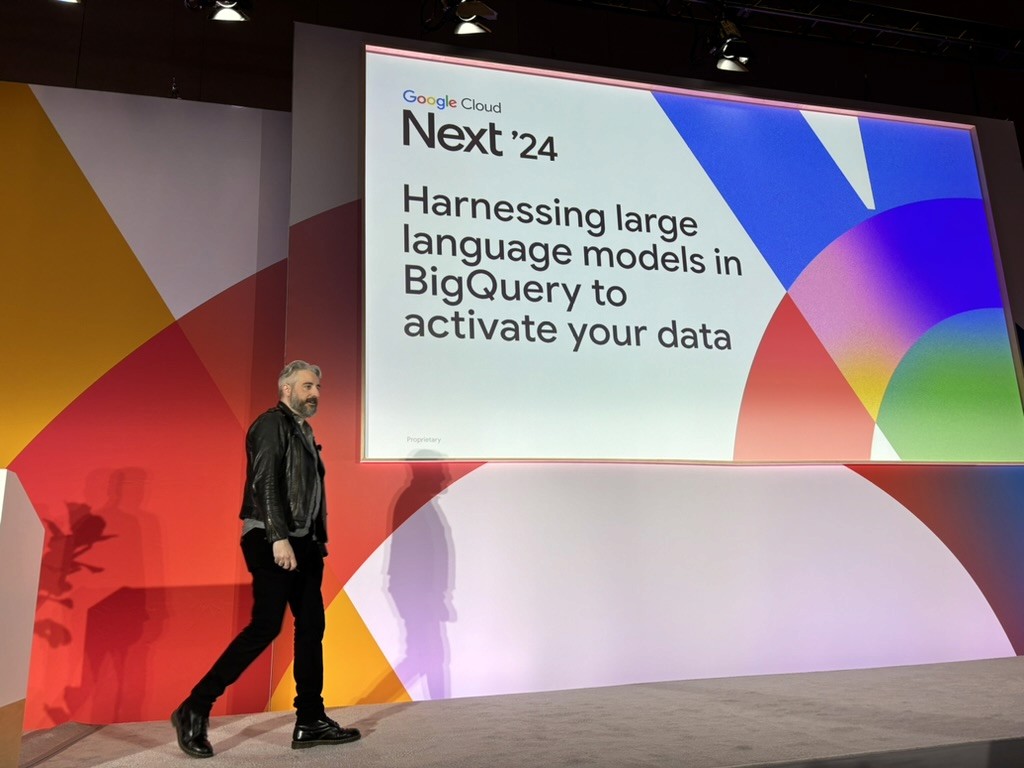
At Google Cloud Next '24, three standout sessions painted a vivid picture of how enterprises are moving beyond AI experimentation and into tangible, scalable implementations. From high-performance vector search at Uber and Dow Jones, to leveraging generative AI in BigQuery at Unilever, and transforming business data into conversational insights at Kenvue, these talks revealed how companies are unlocking AI’s full potential.
The common thread? AI is no longer a nice-to-have; it’s an enterprise necessity. Whether it’s Retrieval-Augmented Generation (RAG) for real-time decision-making, democratizing AI with SQL-driven LLMs, or embedding natural language search in business intelligence, the message was clear: AI isn’t replacing humans—it’s amplifying their ability to make smarter decisions, faster.
1. Retrieval-Augmented Generation (RAG) and Vector Search: The AI Engine Powering Scalable Applications
The first session tackled one of the biggest challenges in AI adoption: contextual accuracy and efficiency in generative AI applications.
At Uber, Dow Jones, and Google Cloud, AI engineers are enhancing LLMs with retrieval-augmented generation (RAG)—a technique that grounds generative models with real-world data, reducing hallucinations and ensuring reliable responses.
Key Takeaways
Uber’s Real-Time Search & Recommendation AI: Uber relies on Vertex AI Vector Search to retrieve embeddings at lightning speed, optimizing search, recommendations, and ad serving.
Multimodal RAG at Dow Jones: Dow Jones is expanding retrieval across text, images, and other media, leveraging customized document understanding pipelines for richer insights.
The Power of Fine-Tuned RAG: By combining document embeddings with knowledge graphs, these companies ensure context-aware AI outputs that don’t just generate responses, but generate accurate responses.
What the Experts Say
Arindam Bhattacharya, Staff ML Engineer at Uber, explained that low-latency retrieval is the backbone of scalable AI apps. “The faster we retrieve relevant embeddings, the more fluid and human our AI-powered experiences feel.”
Meanwhile, Clarence Kwei, SVP Engineering at Dow Jones, emphasized that multi-modal retrieval is the next frontier: “We’re moving beyond text—we need AI that can analyze and retrieve context across images, video, and structured data.”
The big takeaway? RAG isn’t just an AI enhancement—it’s a requirement for companies that need AI models grounded in real-world data.
2. BigQuery + Generative AI: How Enterprises Are Activating Their Data
The next session showcased how Unilever is embedding generative AI into its data strategy using BigQuery, transforming unstructured data into enterprise intelligence.
Unilever’s approach hinges on democratizing AI through SQL-driven LLMs—removing the complexity of traditional machine learning and making AI accessible to data professionals who aren’t full-time ML engineers.
Key Takeaways
Gen AI Meets SQL: BigQuery now allows enterprises to run LLMs using simple SQL queries, reducing reliance on specialized ML teams.
Unleashing the Power of Unstructured Data: By embedding LLMs into analytics workflows, companies can extract insights from images, documents, and even audio files without extensive preprocessing.
Enterprise AI Needs Governance: BigQuery’s AI integration ensures full visibility, security, and compliance, a critical factor for regulated industries like finance and consumer goods.
What the Experts Say
Michael Kilberry, Head of Product - AI/ML at Google Cloud, broke it down simply: “AI is only as good as the data it’s built on. By embedding AI into BigQuery, we’re making it easy to scale insights across the organization.”
Meanwhile, Unilever’s Michael Chin showcased how the company accelerates experimentation and model deployment by keeping everything within BigQuery: “We went from AI being a niche R&D project to it being something our entire data team can use.”
The message? The future of AI isn’t locked in Python notebooks—it’s in enterprise-wide data platforms where anyone can leverage it.
3. AI-Powered Business Intelligence: Making Data Conversational with Looker
The final session explored how Kenvue (formerly Johnson & Johnson Consumer Health) is turning business data into real-time, AI-driven insights—without requiring teams to write a single line of SQL.
The shift? Moving from static dashboards to interactive, AI-powered conversations with data.
Key Takeaways
BI Meets Natural Language: Looker’s AI-powered assistant enables users to “talk” to their data, surfacing insights instantly without writing queries.
Auto-Generated Reports & Slides: AI-powered workflows automatically summarize trends and generate reports, removing hours of manual work.
Real-Time Marketing Intelligence: Kenvue uses Looker + Gemini AI to segment audiences, predict consumer behavior, and personalize marketing campaigns.
What the Experts Say
Ani Jain, Senior Outbound Product Manager at Google Cloud, put it bluntly: “Most BI tools are stuck in the past. We’re building Looker to feel like ChatGPT—but for your business data.”
Randip Mitra, Head of Global Strategy at Kenvue, shared how this AI-driven approach is reshaping how their teams interact with data: “Before, getting insights meant waiting on analysts. Now, marketers can just ask a question, and AI delivers the answers in seconds.”
The bottom line? Business intelligence is shifting from query-based dashboards to AI-driven conversations, making insights instant, intuitive, and actionable.
Final Thoughts: The AI-First Enterprise Is Here
If Google Next ‘24 made anything clear, it’s this: AI is no longer experimental—it’s foundational.
From hyper-scalable RAG pipelines to SQL-powered LLMs and AI-driven BI, companies that embed AI directly into their core workflows will define the future.
The key takeaways?
RAG + Vector Search are making generative AI apps smarter and faster.
BigQuery + AI are unlocking the full potential of enterprise data—structured and unstructured.
AI-driven BI is replacing static dashboards with real-time, conversational insights.
The winners in AI? The companies that stop treating it as a standalone project—and start treating it as an enterprise-wide capability.