Google Cloud Next '24 Blog Series: How Google, Commerzbank Bank, and Wayfair Are Redefining Code with AI
At Google Cloud Next '24, industry leaders from Google Cloud, Commerzbank Bank, and Wayfair shared how AI is reshaping software development, optimizing workflows, and accelerating enterprise adoption. AI is no longer just a coding assistant—it’s becoming an integral part of the software delivery lifecycle, tackling everything from onboarding developers to refactoring legacy code at scale. Here’s a deep dive into the most compelling insights and real-world applications.
Gemini Code Assist: AI as a Full-Stack Developer Partner
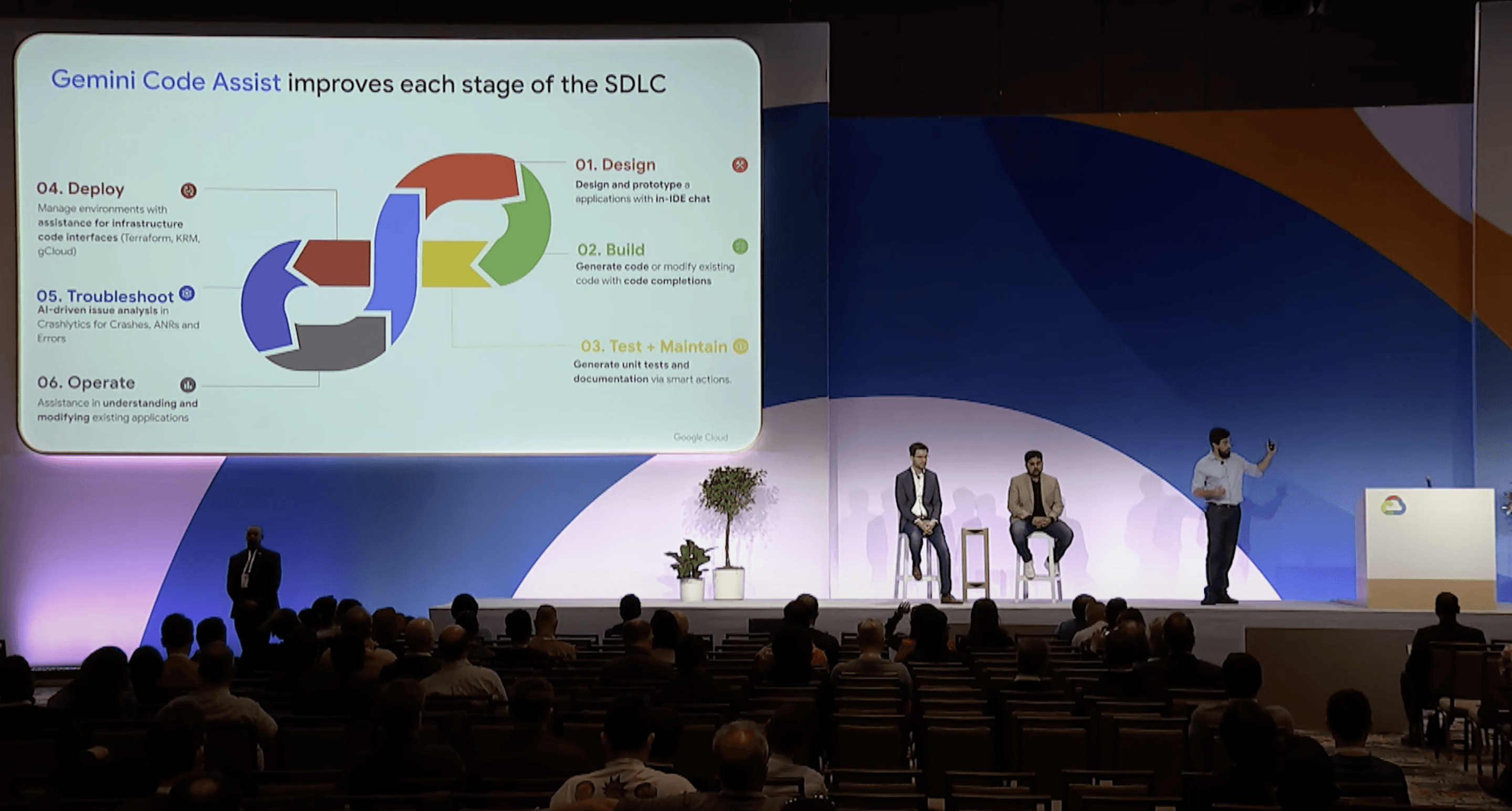
Google’s Gemini Code Assist is more than an autocomplete tool—it’s an AI-powered collaborator embedded across every stage of the software development lifecycle. From designing architectures to automating testing and troubleshooting production issues, Gemini is enabling developers to work smarter, not harder.
Key Takeaways:
Full-Lifecycle AI Integration: Gemini Code Assist extends beyond writing code, offering context-aware suggestions in design, testing, deployment, and maintenance.
Reducing Developer Onboarding Time: New developers can now grasp unfamiliar codebases in minutes, thanks to AI-powered code explanations and repository insights.
Eliminating Context Switching: Instead of bouncing between Stack Overflow, documentation, and GitHub, developers get inline assistance directly in their IDEs.
Code Transformations at Scale: AI can refactor entire repositories, not just individual files—saving weeks of effort when modernizing legacy code.
What the Experts Say:
Marcus Graa, Product Manager for Gemini Code Assist, highlighted that AI isn't just about writing new code—it's about making existing code better. One of the standout capabilities announced at Google Next was Code Transformations, where developers can use natural language prompts to refactor, optimize, and modernize their codebases. Devian Shat, another Product Manager on the Gemini team, emphasized that AI-driven full-codebase awareness enables Gemini to analyze and suggest improvements across entire projects, rather than being limited to isolated snippets.
Commerzbank Bank's Christian Goru shared how their team has been leveraging Gemini Code Assist inside Cloud Workstations to enhance security, streamline operations, and improve developer efficiency in the highly regulated financial sector.
AI-Powered Development at Scale: The Commerzbank Bank Journey
Financial institutions face unique challenges in adopting AI, balancing innovation, compliance, and security. Commerzbank Bank showcased how they integrated AI-driven coding workflows with strict regulatory guardrails, proving that even highly regulated industries can embrace AI for software development.
Key Takeaways:
Cloud Workstations + AI = Secure Dev Environments: Commerzbank Bank uses Google Cloud Workstations with Gemini Code Assist to create secure, customizable development environments.
1-Day Developer Onboarding: Their "1D 1D" (One Developer, One Day) initiative ensures that new hires can start coding within 24 hours, a process that used to take weeks.
Regulatory Compliance with AI: AI helps ensure that code adheres to strict security policies, supporting financial industry requirements such as data protection, encryption, and auditability.
Automated Testing and Security Audits: AI-generated test cases, vulnerability scans, and compliance checks reduce human errors while improving software quality.
What the Experts Say:
Christian Goru, VP of Cyber Excellence at Commerzbank Bank, emphasized that AI is no longer an experimental tool—it’s a necessity. By leveraging Gemini Code Assist inside customized Cloud Workstations, their team has created a developer workflow that balances agility with security. He highlighted that one of the most significant benefits of AI-driven coding is its ability to automate documentation and testing, ensuring compliance while speeding up the development cycle.
From AI Experiments to Production: Lessons from Enterprise Adoption
Many companies struggle with scaling AI from proof-of-concept to enterprise-wide adoption. Wayfair provided an inside look at how they’ve successfully integrated AI into their development workflows, boosting developer productivity while maintaining software quality.
Key Takeaways:
AI-Driven Testing Boosts Code Quality: AI-generated unit tests increased test coverage by 48%, ensuring more robust and error-free applications.
Accelerating Code Reviews: Developers spend less time on repetitive code reviews by letting AI suggest improvements, bug fixes, and optimizations.
AI as a Developer Productivity Multiplier: Beyond efficiency, 60% of developers reported feeling more satisfied with their work, as AI frees them from mundane coding tasks.
Real Measured Impact: Controlled experiments showed that AI-assisted coding reduced task completion times by 20-50%, depending on complexity.
What the Experts Say:
Wayfair’s AI team emphasized that one of AI’s most overlooked benefits is its impact on developer happiness. By automating repetitive coding tasks, test writing, and documentation, AI allows engineers to focus on more engaging, high-value work. Google Cloud’s AI team echoed this sentiment, reinforcing that AI should be seen as a developer’s partner, not a replacement.
Final Thoughts: AI Is Reshaping Software Development
AI is no longer a futuristic vision—it’s actively transforming how enterprises build, test, and deploy software today. From automating developer onboarding to modernizing entire codebases, the companies leading this AI-driven transformation are seeing massive gains in efficiency, security, and software quality.
The key takeaway? Companies that integrate AI into their software development pipelines today will have a competitive edge tomorrow. AI is no longer just a coding assistant—it’s a critical part of the modern software engineering process.