Google Cloud Next '24 Blog Series: Real-Time AI in Streaming How Google Cloud and Spotify Are Redefining Data Processing
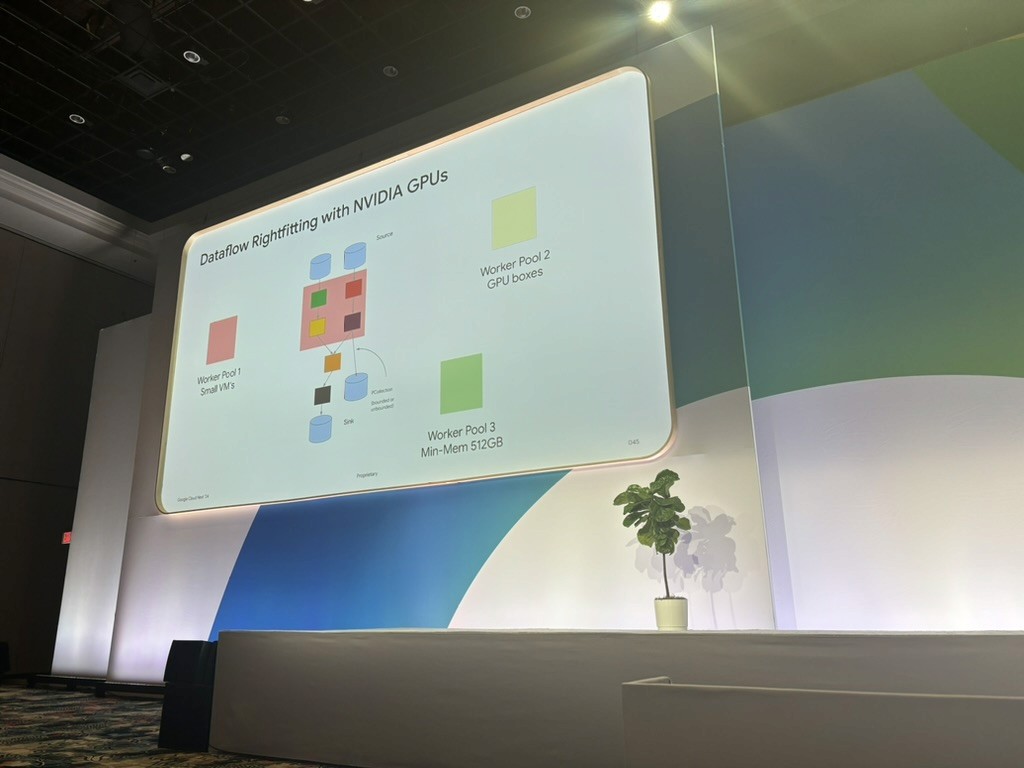
At Google Cloud Next '24, leaders from Google Cloud and Spotify explored how real-time AI and streaming machine learning are transforming data processing at scale. The days of batch processing and delayed insights are over—companies are now leveraging AI-powered stream processing to optimize customer experiences, increase efficiency, and enhance predictive capabilities.
Let’s break down the key takeaways from this session and explore how AI is being deployed in real time to reshape industries.
Google Dataflow: The Backbone of Real-Time AI
Google Cloud’s Dataflow is a fully managed, serverless stream and batch data processing service, built on Apache Beam. It powers real-time analytics, allowing organizations to act on insights as they happen. At Next ‘24, Google unveiled major AI-driven enhancements to Dataflow, making it even more efficient for real-time ML workloads.
Key Takeaways:
From Batch to Streaming AI: Traditional ML pipelines often operate in batch mode, creating delays. With Dataflow, AI models can now ingest and process data in real time.
Turnkey ML Transforms: Google has introduced RunInference and MLTransform, making it easier than ever to deploy AI models at scale with just a few lines of code.
Multi-Model Pipelines: Dataflow now supports multiple ML models in a single DAG, allowing companies to run diverse AI tasks—such as classification, sentiment analysis, and prediction—within the same pipeline.
Hot-Swappable Models: ML models can now be updated in real time without restarting pipelines, ensuring continuous improvement and adaptability.
What the Experts Say:
Sain Agal, Group Product Manager at Google Cloud, highlighted that “speed is a feature” when it comes to ML-driven insights. He explained how Google’s innovations in serverless data streaming and ML integration allow businesses to make decisions instantly, whether optimizing user recommendations or detecting fraud in financial transactions.
Spotify’s AI-Powered Podcast Previews: A Game-Changer for Content Discovery
Spotify is leveraging Dataflow and AI to solve a fundamental challenge in podcast discovery: helping users find content they’ll love without having to listen to entire episodes. Their AI-driven Podcast Previews system extracts key moments from episodes, generating short previews to help users decide what to listen to next.
Key Takeaways:
AI-Generated Previews: Spotify processes hundreds of thousands of new episodes daily, using ML models to extract engaging 1-minute clips.
Language Detection at Scale: A custom language identification model ensures that only relevant content enters the ML pipeline, improving accuracy.
Multi-Model AI Pipelines: AI models classify speech vs. music, detect ads, analyze sentiment, and extract topics, creating seamless, high-quality previews.
Speed & Scale: Transitioning from batch processing to real-time streaming reduced preview generation time from 2 hours to just 4 minutes.
What the Experts Say:
Edgar, Machine Learning Engineer at Spotify, emphasized that real-time AI isn’t just about speed—it’s about user experience. “The faster we can surface high-quality previews, the more engaging the listening experience becomes,” he noted. He also highlighted the technical challenge of running multiple ML models on long-form audio, requiring efficient resource allocation and dependency management.
The Future of Real-Time AI: Smarter, Faster, and More Scalable
The transition from batch to real-time AI is a paradigm shift in how businesses process and act on data. Google Cloud and Spotify showcased how AI-powered stream processing can enhance user experiences, optimize operations, and scale effortlessly.
Key Innovations to Watch:
Dynamic Resource Allocation: AI workloads can now scale on demand, ensuring optimal efficiency for both lightweight and computationally intensive tasks.
Democratizing AI with Low-Code Solutions: With RunInference and MLTransform, companies no longer need large ML engineering teams to deploy real-time AI.
Seamless Model Updates: Businesses can update AI models on the fly, ensuring that insights remain accurate without downtime.
Final Thoughts: Real-Time AI is the Future
The days of waiting for batch jobs to complete are over. AI-driven stream processing is revolutionizing industries, from content discovery to fraud detection. Companies that embrace real-time AI will be able to respond faster, personalize experiences better, and stay ahead of the competition.
The question is no longer if businesses should adopt real-time AI—it’s how fast can they do it?