Google Cloud Next '24 Blog Series: The Future of Search - How AI and RAG Are Reshaping Enterprise Knowledge Retrieval
At Google Cloud Next '24, a standout session on AI-powered search and Retrieval-Augmented Generation (RAG) revealed how enterprises are moving beyond keyword-based search into the realm of intelligent, generative AI-powered retrieval.
From Forbes rethinking digital content discovery to Google’s Vertex AI Search transforming enterprise data retrieval, the message was clear: AI-driven search is no longer a luxury—it’s a necessity. The session explored how organizations are leveraging LLMs, vector search, and multimodal retrieval to create seamless, real-time, and highly personalized search experiences.
Let’s break down the key insights from this session.
The Death of Keyword Search: Why Generative AI Is Reshaping Search as We Know It
For decades, enterprise search has relied on keyword-based retrieval, often yielding irrelevant, outdated, or incomplete results.
Lisa Ali, Google’s Head of Product Management for Cloud AI, wasted no time addressing the elephant in the room:
"Search sucks."
Traditional search engines struggle with complex queries, contextual understanding, and retrieving insights from diverse data formats. However, Generative AI + Search is changing the game.
Key Takeaways
From Keywords to Meaning: AI-powered search engines understand intent, not just keywords, making information retrieval far more accurate and useful.
RAG is the Future: Retrieval-Augmented Generation (RAG) grounds LLMs with real-world, real-time data, eliminating hallucinations and enhancing accuracy.
Multimodal Search is Here: Enterprises can now search across text, images, PDFs, structured databases, and real-time content, creating blended, highly relevant results.
The big shift? Search engines are evolving from “finding” information to “understanding” it.
Forbes’ AI-Powered Search Reinvention: Keeping Readers Engaged with Gen AI
For Forbes, search isn’t just about retrieving articles—it’s about keeping users engaged, driving subscriptions, and providing an unmatched reader experience.
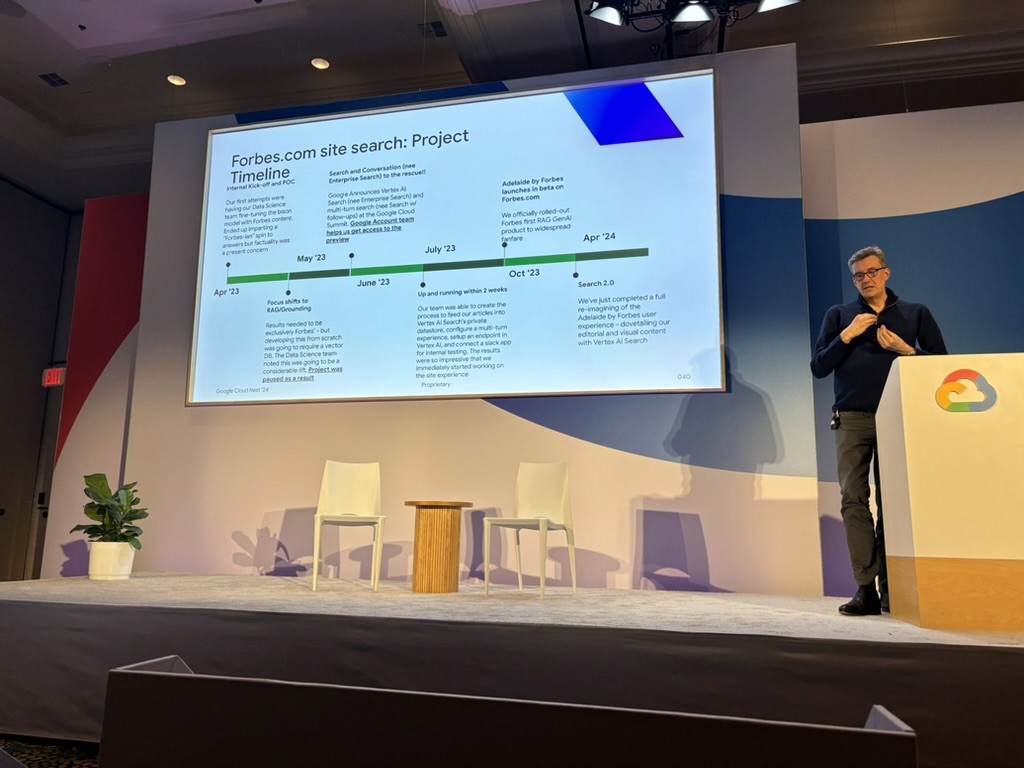
David Johnson, Chief Data Officer at Forbes, shared how the company completely reimagined its search experience using Google’s Vertex AI Search.
Key Takeaways from Forbes' AI Search Transformation
RAG-Enhanced Search Keeps Readers on Site: Instead of directing users to external search engines, Forbes now retrieves, summarizes, and recommends content within its platform.
Search Accuracy Skyrocketed: Forbes replaced legacy keyword-based search with AI-powered contextual search, dramatically improving relevance.
Real-Time Financial Data Retrieval: Forbes integrated live billionaire rankings, stock market data, and crypto trends, making AI-powered search a real-time financial assistant.
Lightning-Fast Deployment: Forbes built its AI search MVP in just two weeks, showcasing how enterprises can rapidly implement AI-driven retrieval.
What the Experts Say
David Johnson didn’t mince words:
“We needed AI search that worked at the speed of news. We had to get away from static keyword matching and start delivering real-time, personalized insights.”
His team leveraged Google’s RAG-powered retrieval to provide real-time insights, reduce user churn, and drive deeper content engagement.
Forbes’ takeaway? If your search isn’t intelligent, conversational, and real-time, you’re already behind.
The AI-Powered Enterprise Search Revolution: Breaking Down Data Silos
Search isn’t just for news and media—it’s an essential enterprise tool for internal knowledge management, customer support, and business operations.
Google showcased how Vertex AI Search is enabling companies to:
Search across disconnected data sources (docs, databases, emails, Slack, Confluence, Jira, etc.)
Blend structured and unstructured data into a unified, intelligent search experience
Leverage generative AI to provide context-aware summaries, citations, and actionable insights
What the Experts Say
Lisa Ali explained that enterprise search isn’t just about finding documents—it’s about making knowledge instantly accessible.
“Your employees shouldn’t spend hours searching for information. AI-powered search lets them find answers in seconds.”
The Future of AI Search: Hybrid Search, Vector Search, and Custom APIs
The final section of the session focused on Google’s latest AI search advancements, including:
Vertex AI Search for Healthcare & Media – AI-powered domain-specific search tailored for medical data, media content, and retail catalogs.
Hybrid Search – A combination of keyword search + vector search, delivering precise and semantically relevant results.
Custom Search APIs – New APIs that let companies fully customize their RAG pipelines, balancing speed, accuracy, and cost.
Final Thoughts: Search is Becoming Conversational, Contextual, and AI-First
Search isn’t just evolving—it’s being completely redefined by generative AI.
The next generation of AI search will be:
Conversational – Instead of searching, users will chat with their data.
Contextual – AI will understand meaning, intent, and history.
Continuous – Search engines will self-improve, refining results over time.
The Takeaway?
If you’re still using old-school, keyword-based search, you’re leaving knowledge—and money—on the table. The companies embedding AI-powered search into their workflows today will be the ones leading tomorrow’s AI-driven enterprise.