Google Cloud Next '24 Blog Series: Inside the Minds of AI Pioneers - Key Takeaways from Dario Amodei and Elad Gil at Cloud Next '24
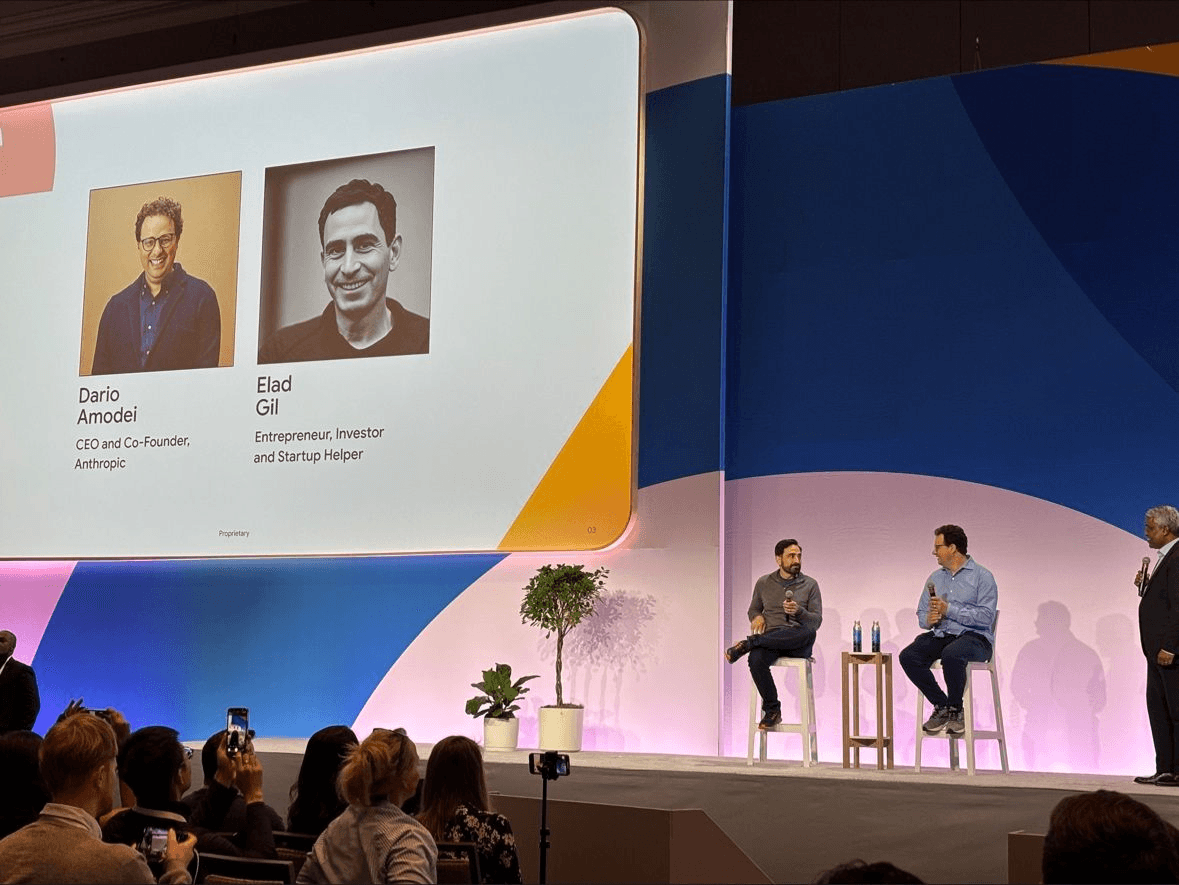
At Google Cloud Next ‘24, a powerhouse discussion between Dario Amodei (CEO and Co-Founder of Anthropic) and Elad Gil (Entrepreneur, Investor, and Startup Advisor) shed light on the real-world applications, challenges, and future trajectory of generative AI. This fireside chat wasn’t just a high-level overview—it was a deep dive into the technical, economic, and ethical landscape of large language models (LLMs) and their transformative potential.
Claude 3 and the Evolution of AI Models
One of the standout topics was Anthropic’s latest release, Claude 3, which introduced three distinct models:
Opus – The most powerful model, optimized for high-reliability tasks.
Sonet – A balanced model that offers strong performance at lower costs.
Haiku – A highly efficient, fast, and cost-effective model with impressive capabilities given its size.
Dario Amodei emphasized that user engagement and personality were a key focus in this iteration. Unlike earlier models that prioritized pure reasoning, Claude 3 aimed to sound more natural, engaging, and human-like, making interactions feel fluid and intuitive.
The Economics of AI: Cost, Compute, and Performance
A fascinating point raised by Amodei was the rapid cost-performance evolution in AI model training. Key insights included:
5x annual increase in training expenditures, despite 1.5-2x cost reduction per floating-point operation (FLOP) each year.
10x growth in effective compute per year, demonstrating the intense demand and rapid scaling of AI models.
Economic momentum is so strong that even with decreasing costs, spending on AI continues to increase due to the competitive race for model dominance.
This dynamic hints at an inevitable shift where only a few entities will have the resources to train frontier models, making cloud infrastructure and partnerships like those between Anthropic and Google critical for ensuring widespread AI access.
Challenges: Hallucinations, Jailbreaks, and Reliability
No discussion on generative AI is complete without addressing its limitations. Some of the biggest technical and ethical challenges highlighted included:
Hallucinations: Even the best models still generate incorrect or misleading information, limiting enterprise adoption in high-stakes fields like healthcare and finance.
Jailbreaks & Security: AI models can be manipulated to bypass safeguards, exposing vulnerabilities in enterprise deployments. Notably, Amodei pointed out that Anthropic models have a much lower jailbreak rate (0-6% vs. 30-90% for competitors).
Long-Term Risks: As AI becomes more autonomous and agentic, the risk of unintended actions increases, requiring robust policy frameworks and safety mechanisms to mitigate potential misuse in fields like biosecurity and cybersecurity.
The Future of LLMs: Scale, Multimodality, and Agents
Looking ahead, Amodei outlined four major trends in LLMs:
Scale-Driven Intelligence: Larger models will push the boundaries of reliability, approaching human-level performance in specialized fields.
Multimodal Capabilities: The integration of video, audio, and even robotic interaction will expand AI’s potential.
Hallucination Reduction: Advances in model architecture and fine-tuning techniques will make AI responses more accurate and verifiable.
AI Agents: The next frontier is moving from static language models to autonomous agents, capable of executing complex, multi-step tasks with minimal human supervision.
Enterprise Adoption: A Three-Pronged Approach
Gil and Amodei discussed how enterprises are deploying AI across three primary categories:
Vendor Solutions: Leveraging third-party AI tools to enhance efficiency and reduce operational costs.
Internal AI Tools: Developing AI-powered automation to boost employee productivity.
Customer-Facing Applications: Embedding AI into products and services to improve user experience and engagement.
Interestingly, different model sizes are preferred based on the use case:
Smaller models (Sonet, Haiku) are ideal for customer-facing applications, where response time is critical.
Larger models (Opus) are better suited for internal enterprise use cases, where accuracy outweighs latency concerns.
The Path Forward: Safety, Customization, and Global Impact
Anthropic’s vision extends beyond commercial applications. They aim to ensure AI is safe, reliable, and beneficial for society. This includes:
A Responsible Scaling Plan: Every new model undergoes rigorous testing for risks such as misuse, bias, and safety vulnerabilities.
Custom Models for Vertical Markets: The future isn’t just about general-purpose models—it’s about building large, customized models for domains like biology, finance, and legal applications.
Global AI Access: Anthropic is working with partners like Liquid Tech to bring AI-driven education and enterprise solutions to underserved regions, ensuring that AI's benefits are equitably distributed.
Final Thoughts: The AI Race is Just Beginning
Cloud Next ‘24 reinforced a key reality: the AI arms race is accelerating at an unprecedented pace. While innovation in scale, multimodality, and agent-based systems is exciting, ensuring AI safety, alignment, and equitable access is just as crucial.
Dario Amodei’s final takeaway?
“The AI field is evolving at an exponential rate. The biggest challenge isn’t just technological—it’s ensuring that this rapid progress benefits humanity while mitigating the risks.”
As we look ahead, enterprises, policymakers, and researchers must collaborate to shape AI’s trajectory, ensuring it enhances productivity, drives economic growth, and serves as a force for good.