Overview
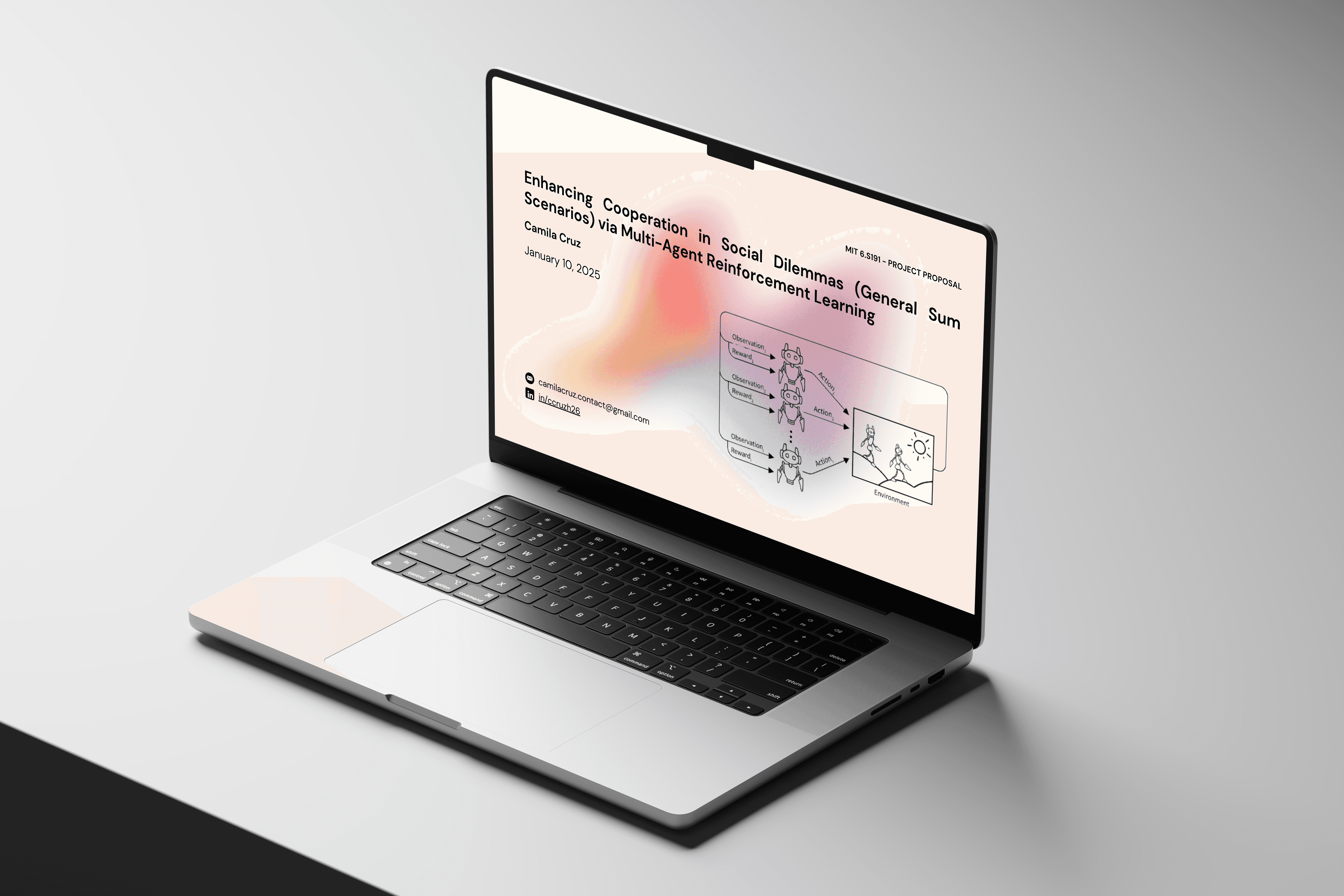
Enhancing Cooperation in Social Dilemmas via Multi-Agent Reinforcement Learning explores methods to foster stable cooperation in general-sum scenarios using reinforcement learning. By extending Stable Opponent Shaping (SOS) and integrating dynamic incentives, the project aims to improve cooperation in environments like the Coin Game and Melting Pot. The research has implications for multi-agent decision-making, resource allocation, and adversarial resilience, with potential applications in robotics, supply-chain optimization, and fraud detection.
Motivations
Multi-Agent Reinforcement Learning (MARL) is a powerful framework for modeling complex systems where autonomous agents interact in shared environments. However, achieving stable cooperation in general-sum social dilemmas—where individual incentives may conflict with collective welfare—remains a critical challenge. Many MARL algorithms excel in purely competitive or cooperative settings, yet struggle in mixed-motive environments, where both elements coexist.
In real-world applications, such as multi-robot coordination, supply-chain optimization, and resource allocation, agents must adapt to dynamic incentives and changing conditions. Without robust cooperation strategies, these systems risk inefficiencies, resource depletion, or collapse into non-cooperative equilibria.
This project is motivated by the need to bridge the gap between existing MARL techniques and realistic social dilemmas, where incentives evolve over time. By extending Stable Opponent Shaping (SOS) and incorporating dynamic reward structures, this research aims to foster emergent cooperation and improve decision-making in multi-agent interactions.
Beyond immediate applications, cooperation in multi-agent systems is a foundational problem in the development of agentic AI. Future AI systems will increasingly operate in open-ended, multi-agent environments—ranging from autonomous economic agents to decentralized governance models. Breakthroughs in MARL cooperation will be critical for scaling agentic AI systems that can negotiate, collaborate, and align with human values. Developing frameworks for stable cooperation today lays the groundwork for more advanced, socially-aware AI agents capable of navigating complex, multi-stakeholder interactions in the future.
Reflections and Learnings
Attending MIT 6.S191: Intro to Deep Learning in person was an incredible experience—one that challenged me academically, technically, and personally in all the right ways. Beyond the cutting-edge lectures, hands-on labs, and thought-provoking guest talks, one of the standout moments for me was the opportunity to present my project proposal.
This was a cool opportunity to probe my idea in a room full of impressive people, including Alexander Amini and Ava Amini, who led the course with exceptional insight, and John Werner, whose energy and strategic vision brought the community together so seamlessly. Engaging in discussions with like-minded peers and faculty pushed my thinking on multi-agent cooperation and its long-term implications in agentic AI. The feedback and diverse perspectives I received helped me refine my approach, question my assumptions, and better articulate the real-world impact of emergent cooperation in AI-driven systems.
A key learning from this experience was just how interdisciplinary and open-ended this research area is. Social dilemmas in multi-agent systems mirror real-world challenges in decision-making, governance, and alignment, making progress in this space essential for the future of AI. This realization has only strengthened my conviction that solving cooperation in multi-agent reinforcement learning is not just an academic pursuit—it’s a foundational step toward the future of scalable, agentic AI.
I’m deeply grateful for the opportunity to learn, present, and exchange ideas with such a dynamic and inspiring group of people. I walk away from this experience with new insights, a stronger research direction, and an even greater excitement for what’s ahead. Looking forward to applying these learnings in my next endeavors! 🚀