Google Cloud Next '24 Blog Series: Inside the Minds of AI’s Pioneers - What’s Next for LLMs, Open Source, and Enterprise AI?
At Google Cloud Next '24, the Founder Series Fireside Chats provided a rare opportunity to hear directly from the architects of modern AI—visionaries who have built the tools, models, and infrastructure that power today’s AI revolution.
From LangChain’s advancements in reasoning agents to Hugging Face’s push for open-source AI in production, and from Contextual AI’s advocacy for retrieval-augmented generation (RAG) to Essential AI’s roadmap for enterprise-ready LLMs, the conversations highlighted the major technical and strategic shifts shaping the future of AI.
Let’s break down the most impactful insights from these sessions—and what they mean for developers, enterprises, and the AI ecosystem as a whole.
LangChain and the Rise of Context-Aware AI Agents
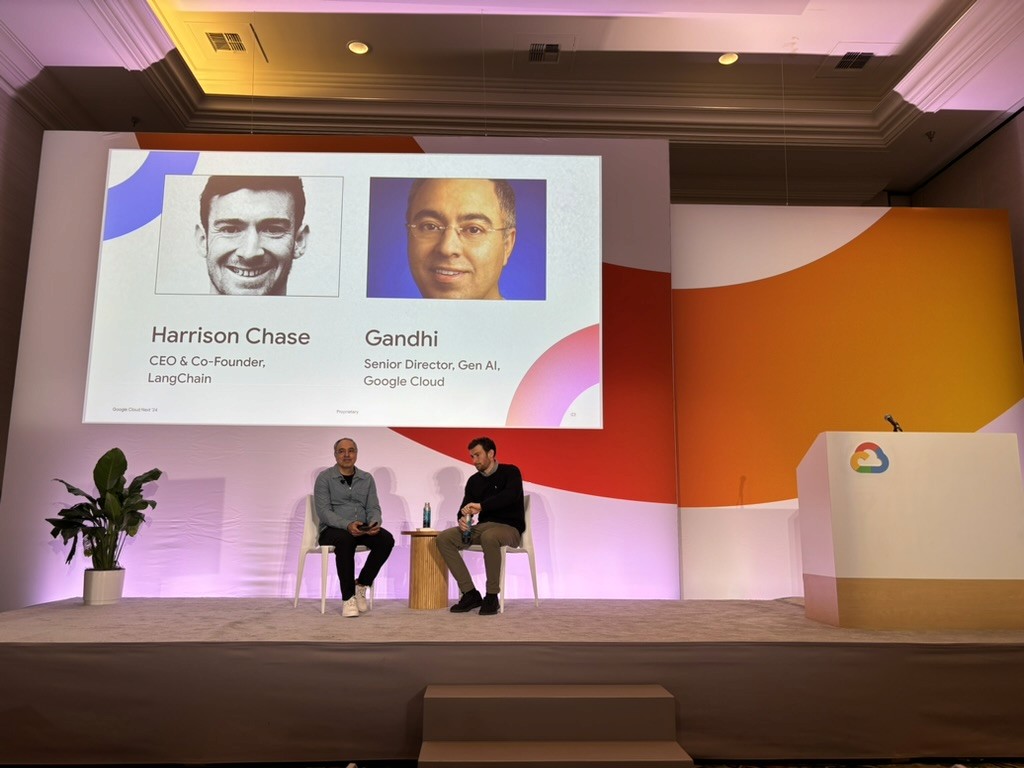
In his fireside chat, Harrison Chase, CEO & Co-Founder of LangChain, laid out a bold vision for the future of AI applications:
LLMs must go beyond text generation—they need contextual awareness, memory, and reasoning capabilities.
LangChain is evolving into a framework for intelligent state machines that can retrieve knowledge, plan multi-step tasks, and reason over structured data.
Google’s AI ecosystem is playing a key role in helping LangChain scale its capabilities, especially in enterprise AI deployments.
What this means: AI agents aren’t just answering questions anymore—they’re learning from context, executing complex workflows, and integrating with structured databases. Enterprises looking to automate decision-making should start experimenting with LangChain-powered agents now.
“The real challenge isn’t just building LLM applications—it’s orchestrating them into intelligent agents that can reason, retrieve, and execute tasks dynamically.”
– Harrison Chase, LangChain
Hugging Face: Taking Open Source AI to Production at Scale
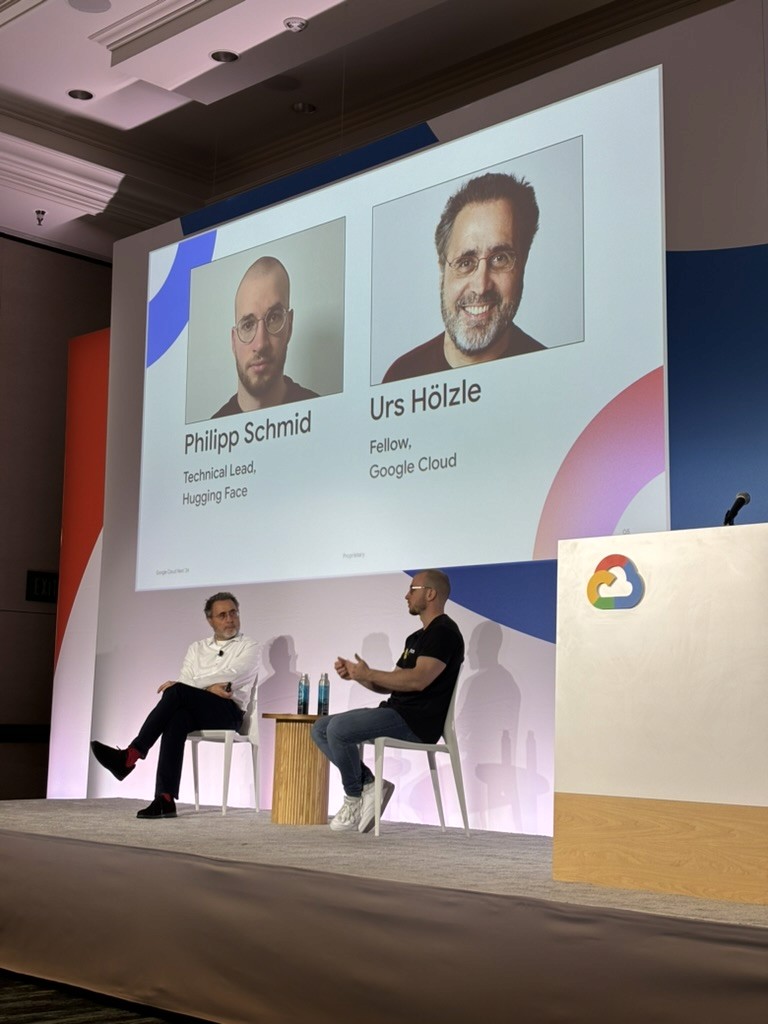
In his chat, Philipp Schmid, Technical Lead at Hugging Face, made a strong case for why open-source AI is winning—and the challenges that still remain.
Key Takeaways:
LLMs in production require more than just fine-tuning—they demand versioning, monitoring, and continuous evaluation to stay reliable.
Data drift and AI evaluation remain unsolved problems—Hugging Face is working on better tools to benchmark AI models over time.
Cloud computing is accelerating AI development, but cost, compute access, and model governance remain key bottlenecks for enterprises.
“Open-source AI is here to stay—but taking it into production at scale requires an entirely new set of MLOps best practices.”
– Philipp Schmid, Hugging Face
What this means: Companies using open-source models (instead of closed API-based LLMs) must invest in better evaluation, monitoring, and governance tools to ensure reliability and compliance.
Essential AI: The Enterprise AI Revolution is Just Beginning
Essential AI, led by Ashish Vaswani and Niki Parmar, is on a mission to bring transformer-based AI to the enterprise. Given that Vaswani co-authored “Attention Is All You Need”, this session provided deep insights into the future of LLM architecture.
Key Takeaways:
Enterprise AI needs more than just LLMs—companies must integrate reasoning, structured retrieval, and domain-specific knowledge.
Custom AI architectures for business use cases will outperform generic LLMs—this is where Essential AI is focusing its efforts.
Transformer models are still evolving—expect innovations in efficiency, scaling, and retrieval augmentation.
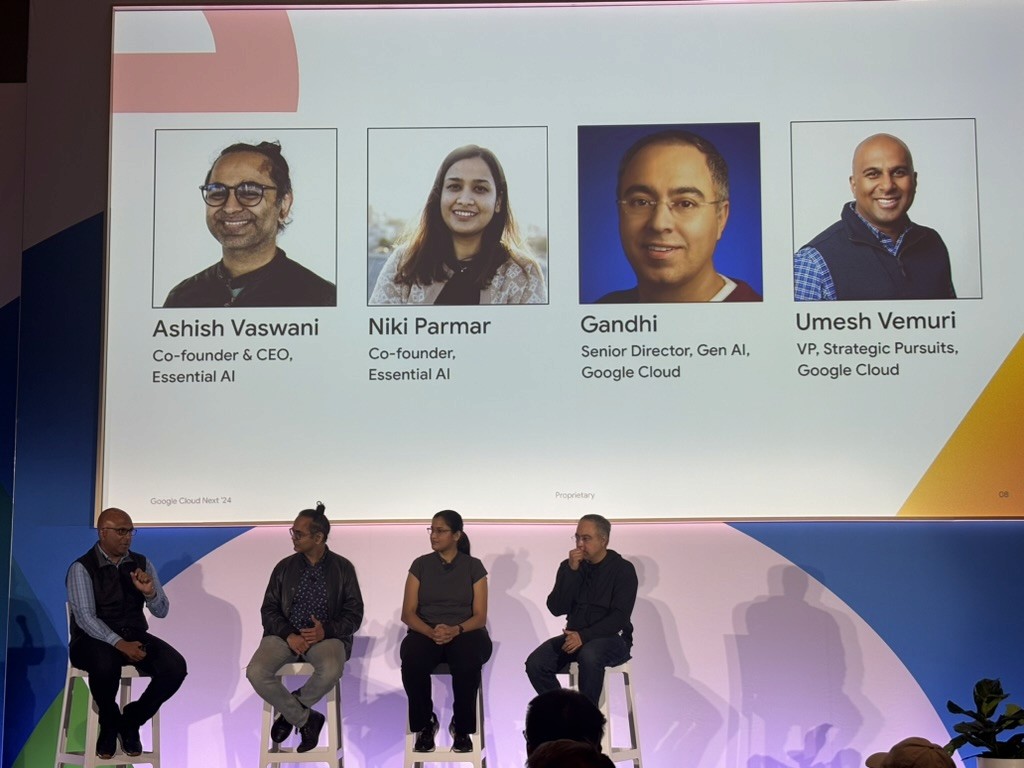
“We built the transformer model, but we’re still just scratching the surface of what’s possible with enterprise AI.”
– Ashish Vaswani, Essential AI
What this means: Large enterprises must start moving beyond one-size-fits-all AI models and focus on custom AI solutions tailored to their domain.
Contextual AI and the Future of Retrieval-Augmented Generation (RAG)
Douwe Kiela, CEO of Contextual AI, is one of the original pioneers of RAG-based LLM deployments (from his work at Facebook AI). In this session, he laid out why RAG is the dominant paradigm for LLM applications—and how companies should be implementing it today.
Key Takeaways:
LLMs alone aren’t enough—they need retrieval mechanisms to access external, up-to-date knowledge.
RAG improves accuracy, reduces hallucinations, and lowers inference costs by avoiding unnecessary token generation.
The future of AI is hybrid—LLMs must be paired with vector search and knowledge graphs for enterprise use cases.
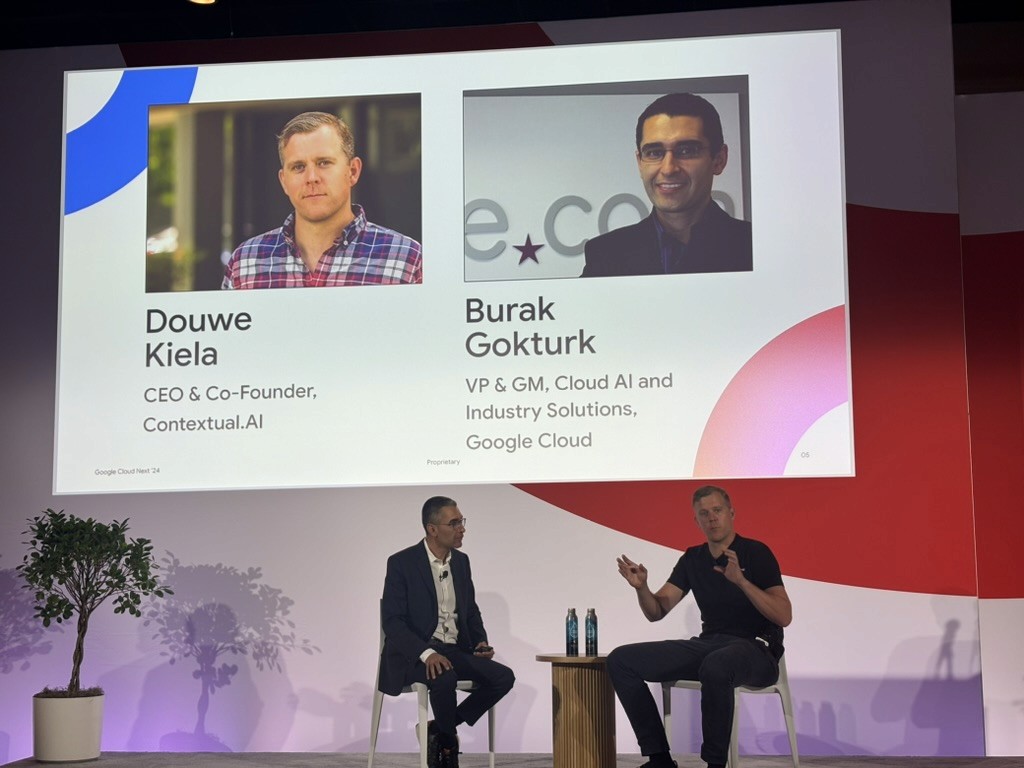
“RAG isn’t just a feature—it’s the core technology that will make AI reliable, scalable, and cost-efficient.”
– Douwe Kiela, Contextual AI
What this means: Companies relying on LLMs for knowledge-heavy applications (customer support, legal, research, finance) should start implementing vector search + retrieval augmentation.
Dario Amodei on the Challenges and Future of Large Language Models
Dario Amodei’s session, which we covered in detail in our previous article, touched on:
The biggest risks in AI today (hallucinations, jailbreaks, model deception).
Opportunities for LLMs in enterprise applications.
How AI policy, research, and collaboration will shape the future.
“The challenge isn’t just building more powerful AI—it’s ensuring that it’s aligned, controllable, and beneficial for society.”
– Dario Amodei, Anthropic
Final Thoughts: The AI Ecosystem is Maturing—But There’s Still Work to Do
The Founder Series at Google Next '24 revealed where AI is heading in 2024 and beyond:
LLMs are becoming reasoning agents (LangChain).
Open-source AI is moving to production at scale (Hugging Face).
Enterprise AI requires new architectures (Essential AI).
Retrieval-Augmented Generation (RAG) is the dominant paradigm (Contextual AI).
LLMs must be aligned, secure, and grounded in reality (Anthropic).
The takeaway?
The AI race is no longer about building bigger models—it’s about making them efficient, reliable, and enterprise-ready.